Structural proofing prevents pests before indoor contamination begins. A standard house mouse needs a gap of only 0.25 inches to access wall voids, while an adult Norway rat can compress through an opening measuring…
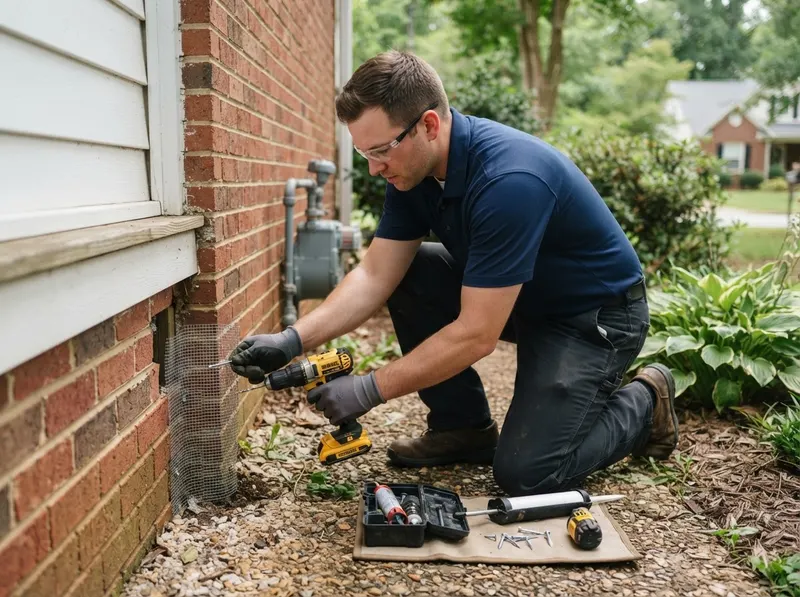
Structural proofing prevents pests before indoor contamination begins. A standard house mouse needs a gap of only 0.25 inches to access wall voids, while an adult Norway rat can compress through an opening measuring 0.5 inches wide, as detailed by the CDC Rodent Prevention Guidelines. In older Richland County homes throughout Earlewood, Cottontown, and Elmwood Park, historic masonry foundations, detached mortar joints, and decorative louvered foundation vents provide clear paths inside. Relying strictly on synthetic bait stations inside living quarters introduces secondary poisoning risks for household pets and often results in carcass decay within inaccessible wall cavities. Mechanical exclusion replaces repetitive pesticide applications with durable building envelope defense, creating a permanent barrier across every exterior transition.
Technicians systematically survey the exterior envelope from grade level to the roofline. Foundation proofing begins by securing crawlspace access doors and sealing ground-level plumbing entries using escutcheon plates backfilled with knitted copper mesh. According to standards published by the EPA Pest Management Program, physical exclusion eliminates food-foraging pathways without chemical runoff into the nearby Congaree watershed. For homes with raised crawlspaces in Shandon, Rosewood, and Old Shandon, technicians replace torn or missing foundation screens with corrosion-resistant 19-gauge, 1/4-inch galvanized steel mesh. This material resists gnawing while maintaining the continuous cross-ventilation ratios prescribed by the U.S. Department of Housing and Urban Development to prevent crawlspace mold accumulation.
Elevated structural transitions present distinct vulnerabilities across heavily wooded residential properties in Heathwood and Forest Acres. Roof rats take advantage of overhanging oak and pine canopies near the Columbia Canal and Riverfront Park to reach construction gaps, including the open spaces where roof decking meets the fascia board, ridge vent terminations, and unscreened attic gable vents. Structural proofing at high elevations requires custom-bent 26-gauge galvanized sheet metal flashing installed along drip edges and soffit intersections, meeting structural guidelines referenced by the National Institute of Standards and Technology. Technicians also secure exterior utility conduits according to safety parameters recognized by the Occupational Safety and Health Administration.
Sealing building seams requires specific materials, as standard expanding polyurethane foam is easily gnawed through by rodents. Technicians pack active voids with pure copper wire mesh before finishing the exterior with elastomeric sealants meeting performance specifications from the ASTM International Standards. To preserve local wildlife near protected spaces like Riverbanks Zoo & Garden and Congaree National Park, exclusion practices align with environmental principles from the U.S. Fish and Wildlife Service and the South Carolina Department of Health and Environmental Control. All structural sealants also conform to safety provisions outlined by the Consumer Product Safety Commission. RiverCrest Bug Control confirms exact labor and material specifications on-site; property owners can arrange a site evaluation by calling (803) 887-7917.
Every job gets a firm, written price after a free on-site visit.
Tell us about your mechanical rodent exclusion & structural proofing job in columbia and we'll send a clear, written quote, usually the same day.
 RiverCrest Bug Control